
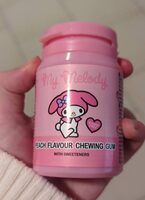
my melody
Unknown brand
Processing
4
Ultra-processed
Group 4 of 4 on the NOVA scale
Additives listed
12
0 we grade moderate or higher
6 of them not yet assessed here
Nutrients
–
Nothing above the low band
Or no figures recorded at all
Three separate readings, kept apart on purpose. This is not a score, and none of it says this product is harmful.
Additives (12)
This label lists 7 sweeteners, 1 acidity regulator, 1 antioxidant, 1 emulsifier, 1 glazing agent and 1 thickener or gelling agent.
E420
Sorbitol
Sweetener and humectant
What it is. A sugar alcohol, about half as sweet as sugar, which also holds moisture.
Why it is used. Used in sugar free sweets and gum, and to keep baked goods soft.
What the evidence says. Not a toxicity question at all. Sugar alcohols are poorly absorbed, so a large amount draws water into the gut and has a laxative effect. That is well established, predictable and dose dependent, which is why the label has to say so.
Permitted. Foods with more than 10 per cent polyols must carry the statement that excessive consumption may produce laxative effects.
Assessed against EFSA, UK FSA. Full entry for E420
E950
Acesulfame K
Artificial sweetener
What it is. A calorie free intense sweetener, often blended with other sweeteners to round out taste.
Why it is used. Used in diet drinks, dairy and confectionery.
What the evidence says. Long treated as safe by regulators. Some recent research on sweeteners and the gut microbiome is ongoing, but nothing has changed the official safety position.
Permitted with an acceptable daily intake in all three regions.
Assessed against EFSA, JECFA. Full entry for E950
E951
Aspartame
Artificial sweetener
What it is. An intense sweetener around 200 times sweeter than sugar, used in tiny amounts.
Why it is used. Sweetens diet drinks, sugar free gum and low calorie desserts.
What the evidence says. In 2023 IARC listed it as possibly carcinogenic, its weakest evidence tier. At the same time the expert intake committee JECFA kept the safe daily limit unchanged, noting you would need a very high daily intake to approach it, roughly a dozen or more cans of diet drink a day for an adult. So headline scary, practically low concern for normal use.
Permitted with an acceptable daily intake. People with the condition PKU must avoid it, which is why packs carry a phenylalanine note.
Assessed against IARC, JECFA, EFSA. Full entry for E951
E955
Sucralose
Artificial sweetener
What it is. An intense sweetener made from sugar, around 600 times sweeter, so it is used in very small amounts.
Why it is used. Sweetens diet drinks, tabletop sweeteners, dairy and baked goods.
What the evidence says. Regulators have treated it as safe for decades and the acceptable daily intake has not changed. Newer laboratory work on a breakdown product, and the general question of sweeteners and the gut microbiome, keep it under discussion, but that work is early and has not moved any official position.
Permitted with an acceptable daily intake in all three regions.
Assessed against EFSA, JECFA. Full entry for E955
E322
Lecithin
Emulsifier
What it is. A natural emulsifier, usually from soya or sunflower.
Why it is used. Keeps chocolate smooth and stops ingredients separating.
What the evidence says. Safe and widely used. Only relevant if the source, such as soya, is an allergen for you.
Permitted freely. Source allergen must be declared.
Assessed against EFSA, JECFA. Full entry for E322
E330
Citric acid
Acidity regulator
What it is. A mild acid found naturally in citrus fruit, made commercially by fermentation.
Why it is used. Adds tartness, balances flavour and helps preserve. One of the most used additives in food.
What the evidence says. Safe at food levels. No credible health concern for the additive itself.
Permitted freely.
Assessed against EFSA, JECFA. Full entry for E330
Also on the label, not assessed here yet
- E321 Butylated hydroxytoluene (BHT) antioxidant
- E414 Acacia gum (gum arabic) thickener
- E421 Mannitol sweetener
- E903 Carnauba wax glazing agent
- E965 Maltitol sweetener
- E967 Xylitol sweetener
Names and jobs come from the register of additives permitted in Great Britain, which we have not finished transcribing: a code shown without a name is a gap in our coverage, not a finding that it is unapproved. Naming one is not grading it either. Full detail appears only where we have an assessment against a named authority, so all of this describes our coverage rather than these additives. Most are common and low concern.
Ingredients
Sweeteners (E420, E965, E967, E421, Sugar Free Chewing Gum with Sweeteners E951, E950, E955), Gum Base, Flavouring, Stabiliser (E414), Acid (E330), Emulsifier (Soya Lecithin E322), Glazing Agent (E903), Antioxidant (E321). Allergen Advice:
As printed on the pack, in the producer's own order: ingredients are listed by weight, so what comes first is most of what is in it. E numbers link to their assessment where we have one.