
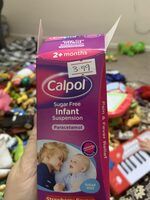
strawberry
calpol
Processing
4
Ultra-processed
Group 4 of 4 on the NOVA scale
Additives listed
8
1 we grade moderate or higher
6 of them not yet assessed here
Nutrients
–
Nothing above the low band
Or no figures recorded at all
Three separate readings, kept apart on purpose. This is not a score, and none of it says this product is harmful.
Additives (8)
This label lists 2 sweeteners, 1 carrier and 1 colour. 4 more we cannot place from the code alone.
E122
Carmoisine
Red colour
What it is. A synthetic red dye, also called azorubine.
Why it is used. Colours jellies, sweets, drinks and desserts.
What the evidence says. One of the Southampton Six. The same modest hyperactivity signal in some children, and the same warning requirement.
Children's activity warning required in the UK and EU. Not approved for food use in the US.
Assessed against UK FSA, EFSA. Full entry for E122
E420
Sorbitol
Sweetener and humectant
What it is. A sugar alcohol, about half as sweet as sugar, which also holds moisture.
Why it is used. Used in sugar free sweets and gum, and to keep baked goods soft.
What the evidence says. Not a toxicity question at all. Sugar alcohols are poorly absorbed, so a large amount draws water into the gut and has a laxative effect. That is well established, predictable and dose dependent, which is why the label has to say so.
Permitted. Foods with more than 10 per cent polyols must carry the statement that excessive consumption may produce laxative effects.
Assessed against EFSA, UK FSA. Full entry for E420
Also on the label, not assessed here yet
- E1519 No entry in our register
- E1520 Propane-1,2-diol carrier
- E214 No entry in our register
- E216 Propyl p-hydroxybenzoate
- E218 No entry in our register
- E965 Maltitol sweetener
1 of these is not on the GB permitted list
E216 Propyl p-hydroxybenzoate — Authorisation withdrawn across the EU in 2006, following EFSA's review of the parabens, which was unable to set an acceptable daily intake for this one.
Absent from Assimilated Regulation (EC) No 1333/2008, Annex II, the register of additives permitted in Great Britain. That is a statement about the food additive register and nothing else: several of these are permitted in medicines, where different rules apply, and this catalogue carries some entries that are not food. Our product data is crowd sourced and worldwide, so on something sold here a code from this list usually means an imported line, an out of date entry, or a mistake in the source rather than anything about the contents. It is not a statement that this product is unsafe, and the pack is the authority.
Names and jobs come from the register of additives permitted in Great Britain, which we have not finished transcribing: a code shown without a name is a gap in our coverage, not a finding that it is unapproved. Naming one is not grading it either. Full detail appears only where we have an assessment against a named authority, so all of this describes our coverage rather than these additives. Most are common and low concern.
Ingredients
contains paracetamol do not give anything else containing paracetamol while giving this medicine. talk to a doctor at once if your child takes too much of this medicine, even if they seem well. as with all medicines, if your child is currently taking any other medicine consult your doctor or pharmacist before using this product. please see leaflet. keep out of the sight and reach of children. check that the cap on the bottle is securely engaged at all times. c. contents: each 5 ml contains 120 mg of paracetamol, also contains: maltitol, sodium, benzyl alcohol, e1520, e420, e214, e216, e218 and e122. do not store above 25°c. keep bottle in the outer carton.
As printed on the pack, in the producer's own order: ingredients are listed by weight, so what comes first is most of what is in it. E numbers link to their assessment where we have one.