
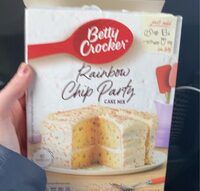
rainbow chip party cake mix
Processing
4
Ultra-processed
Group 4 of 4 on the NOVA scale
Additives listed
14
0 we grade moderate or higher
10 of them not yet assessed here
Sugars per 100g
26.62g
High
UK FSA front of pack threshold
Three separate readings, kept apart on purpose. This is not a score, and none of it says this product is harmful.
Additives (14)
This label lists 6 colours, 2 emulsifiers, 2 raising agents, 2 thickeners and gelling agents, 1 anticaking agent and 1 antioxidant.
E471
Mono- and diglycerides of fatty acids
Emulsifier
What it is. Fat derived emulsifiers, closely related to ordinary dietary fats.
Why it is used. One of the most used additives in food: bread, margarine, ice cream, cakes and sauces.
What the evidence says. The body handles these much as it handles other fats, and EFSA's re-evaluation raised no safety concern at the levels used. They sit in the same broad emulsifier and gut microbiome research question as the others, which remains unsettled.
Permitted without a numerical limit. The fat source is not always stated, which matters for some diets rather than for safety.
Assessed against EFSA. Full entry for E471
E160A
Carotenes
Yellow to orange colour
What it is. The orange pigments found in carrots and other vegetables, either extracted or made synthetically.
Why it is used. Colours margarine, soft drinks, dairy, and sweets.
What the evidence says. The same compound the body turns into vitamin A, and safe at the levels used in food. High dose beta-carotene supplements have been linked to harm in smokers, but those doses are far above anything a colour in food delivers, and conflating the two is a common mistake.
Permitted. The supplement findings apply to concentrated doses, not to food colouring.
Assessed against EFSA, JECFA. Full entry for E160A
E300
Ascorbic acid (vitamin C)
Antioxidant
What it is. Vitamin C, added to protect colour and flavour and sometimes to fortify.
Why it is used. Stops browning in juices and cut fruit, protects fats, and boosts vitamin content.
What the evidence says. Beneficial and harmless at the levels used. Included here as a reminder that an E number is just a code, and plenty of them are ordinary nutrients.
Permitted freely, no concern.
Assessed against EFSA, JECFA. Full entry for E300
E415
Xanthan gum
Thickener and stabiliser
What it is. A fibre made by fermenting sugars with a bacterium, which thickens liquids at very low doses.
Why it is used. Thickens sauces and dressings and gives structure to gluten free baking.
What the evidence says. Passes through largely undigested and is treated as safe by regulators, with no numerical intake limit. Very large amounts act as fibre does, which is a digestive effect rather than a safety one.
Permitted freely.
Assessed against EFSA, JECFA. Full entry for E415
Also on the label, not assessed here yet
- E101 Riboflavin colour
- E120 Cochineal, carminic acid, carmines colour
- E132 Indigotine, indigo carmine colour
- E133 Brilliant blue FCF colour
- E141 Copper complexes of chlorophylls colour
- E341 Calcium phosphates raising agent
- E413 Tragacanth thickener
- E481 Sodium stearoyl-2-lactylate emulsifier
- E500 Sodium carbonates raising agent
- E570 Fatty acids anticaking agent
Names and jobs come from the register of additives permitted in Great Britain, which we have not finished transcribing: a code shown without a name is a gap in our coverage, not a finding that it is unapproved. Naming one is not grading it either. Full detail appears only where we have an assessment against a named authority, so all of this describes our coverage rather than these additives. Most are common and low concern.
Ingredients
sugar, wheat flour, palm fat, raising agents (calcium phosphates, sodium carbonates), corn starch, emulsifiers (propane-1,2-diol esters of fatty acids, mono - and diglycerides of fatty acids, sodium stearoyl-2-lactylate), dextrose, rice flour, salt, stabiliser (xanthan gum), flavouring, thickener (tragacanth gum), colours (carotenes, indigo carmine, copper complexes of chlorophylls, riboflavins, carmines, brilliant blue fcf), flour treatment agent (ascorbic acid).
As printed on the pack, in the producer's own order: ingredients are listed by weight, so what comes first is most of what is in it. E numbers link to their assessment where we have one.