
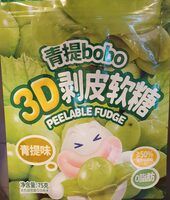
Peelable Fudge
bobo
Processing
4
Ultra-processed
Group 4 of 4 on the NOVA scale
Additives listed
11
3 we grade moderate or higher
5 of them not yet assessed here
Sugars per 100g
77g
High
UK FSA front of pack threshold
Three separate readings, kept apart on purpose. This is not a score, and none of it says this product is harmful.
Additives (11)
This label lists 3 acidity regulators, 3 colours, 3 thickeners and gelling agents and 1 sweetener. 1 more we cannot place from the code alone.
E102
Tartrazine
Yellow colour
What it is. A synthetic lemon yellow dye.
Why it is used. Colours soft drinks, sweets, sauces and snacks.
What the evidence says. One of the Southampton Six colours linked in a 2007 UK study to increased hyperactivity in some children. The effect is modest and does not affect every child, but it was enough for a mandatory on pack warning.
UK and EU require the label to warn it may affect activity and attention in children. Permitted in the US without that warning.
Assessed against UK FSA, EFSA. Full entry for E102
E110
Sunset Yellow FCF
Orange-yellow colour
What it is. A synthetic orange yellow dye.
Why it is used. Colours squashes, sweets, snacks and desserts.
What the evidence says. Also one of the Southampton Six, carrying the same signal for hyperactivity in sensitive children.
UK and EU require the children's activity warning. Permitted in the US.
Assessed against UK FSA, EFSA. Full entry for E110
E171
Titanium dioxide
Whitener and opacifier
What it is. A bright white pigment used to make sweets, icing, sauces and coatings look opaque and white.
Why it is used. Purely cosmetic. It changes appearance, not taste or safety of the food.
What the evidence says. In 2021 the EU food safety body EFSA concluded it could no longer be considered safe as a food additive, mainly because possible genetic damage from the tiny particles could not be ruled out. That is a precautionary call rather than proof of harm in people.
Banned as a food additive in the EU since 2022. Still permitted in the UK and the US, which reached different conclusions on the same evidence. A clear case of the same additive, different rules.
Assessed against EFSA, UK FSA, US FDA. Full entry for E171
E407
Carrageenan
Thickener and stabiliser
What it is. A gel forming fibre extracted from red seaweed.
Why it is used. Thickens dairy, plant milks, desserts and some processed meats.
What the evidence says. Food grade carrageenan is permitted. A degraded form called poligeenan is harmful, but that is not what goes into food. Some lab and animal work links carrageenan to gut inflammation, which keeps it under review, but human evidence is limited and mixed.
Permitted, including in organic food in many places, though a few specialist products avoid it as a precaution.
Assessed against EFSA, JECFA. Full entry for E407
E420
Sorbitol
Sweetener and humectant
What it is. A sugar alcohol, about half as sweet as sugar, which also holds moisture.
Why it is used. Used in sugar free sweets and gum, and to keep baked goods soft.
What the evidence says. Not a toxicity question at all. Sugar alcohols are poorly absorbed, so a large amount draws water into the gut and has a laxative effect. That is well established, predictable and dose dependent, which is why the label has to say so.
Permitted. Foods with more than 10 per cent polyols must carry the statement that excessive consumption may produce laxative effects.
Assessed against EFSA, UK FSA. Full entry for E420
E330
Citric acid
Acidity regulator
What it is. A mild acid found naturally in citrus fruit, made commercially by fermentation.
Why it is used. Adds tartness, balances flavour and helps preserve. One of the most used additives in food.
What the evidence says. Safe at food levels. No credible health concern for the additive itself.
Permitted freely.
Assessed against EFSA, JECFA. Full entry for E330
Also on the label, not assessed here yet
- E296 Malic acid acidity regulator
- E331 Sodium citrates acidity regulator
- E406 Agar thickener
- E440 Pectin thickener
- E441 No entry in our register
Names and jobs come from the register of additives permitted in Great Britain, which we have not finished transcribing: a code shown without a name is a gap in our coverage, not a finding that it is unapproved. Naming one is not grading it either. Full detail appears only where we have an assessment against a named authority, so all of this describes our coverage rather than these additives. Most are common and low concern.
Ingredients
Glucose Syrup, Sugar, Concentrated Mango Juice, Mango Puree, Food Additives (Emulsifier [E441, E420ii, E407, E440], Acid [E330, E296], Acidity Regulator [E331], Stabiliser [E406], Colour [E171, E110, E102], Food Flavour).
As printed on the pack, in the producer's own order: ingredients are listed by weight, so what comes first is most of what is in it. E numbers link to their assessment where we have one.