
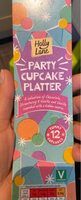
Party cupcake platter
Unknown brand
Processing
4
Ultra-processed
Group 4 of 4 on the NOVA scale
Additives listed
24
1 we grade moderate or higher
16 of them not yet assessed here
Sugars per 100g
43g
High
UK FSA front of pack threshold
Three separate readings, kept apart on purpose. This is not a score, and none of it says this product is harmful.
Additives (24)
This label lists 7 colours, 4 emulsifiers, 4 thickeners and gelling agents, 3 acidity regulators, 2 glazing agents, 2 preservatives, 1 additive and 1 raising agent.
E171
Titanium dioxide
Whitener and opacifier
What it is. A bright white pigment used to make sweets, icing, sauces and coatings look opaque and white.
Why it is used. Purely cosmetic. It changes appearance, not taste or safety of the food.
What the evidence says. In 2021 the EU food safety body EFSA concluded it could no longer be considered safe as a food additive, mainly because possible genetic damage from the tiny particles could not be ruled out. That is a precautionary call rather than proof of harm in people.
Banned as a food additive in the EU since 2022. Still permitted in the UK and the US, which reached different conclusions on the same evidence. A clear case of the same additive, different rules.
Assessed against EFSA, UK FSA, US FDA. Full entry for E171
E202
Potassium sorbate
Preservative
What it is. The potassium salt of sorbic acid, which stops mould and yeast growth.
Why it is used. Used in cheese, baked goods, dried fruit, wine and dressings.
What the evidence says. Widely used and long regarded as one of the gentler preservatives. EFSA's 2015 re-evaluation lowered the acceptable daily intake and noted gaps in the genotoxicity data, asking for more work, while finding no evidence of harm at the levels actually used.
Permitted with maximum levels. EFSA has asked for further data rather than restricted it.
Assessed against EFSA. Full entry for E202
E466
Carboxymethyl cellulose
Thickener and stabiliser
What it is. A modified plant fibre used to thicken and stabilise.
Why it is used. Common in ice cream, low fat products, gluten free bakery and sauces.
What the evidence says. Falls in the same emulsifier and gut research bucket as polysorbate 80, with early human work hinting at effects on the microbiome. Interesting, not conclusive.
Permitted with limits.
Assessed against EFSA. Full entry for E466
E471
Mono- and diglycerides of fatty acids
Emulsifier
What it is. Fat derived emulsifiers, closely related to ordinary dietary fats.
Why it is used. One of the most used additives in food: bread, margarine, ice cream, cakes and sauces.
What the evidence says. The body handles these much as it handles other fats, and EFSA's re-evaluation raised no safety concern at the levels used. They sit in the same broad emulsifier and gut microbiome research question as the others, which remains unsettled.
Permitted without a numerical limit. The fat source is not always stated, which matters for some diets rather than for safety.
Assessed against EFSA. Full entry for E471
E100
Curcumin
Yellow colour
What it is. The yellow pigment from turmeric root.
Why it is used. Colours mustards, sauces, dairy, confectionery and savoury snacks.
What the evidence says. A plant pigment people have eaten as a spice for a very long time, and regulators treat it as safe with an acceptable daily intake. EFSA noted that children who eat a lot of the foods it is used in could approach that intake, which is a reason to watch total use rather than a sign of harm.
Permitted with maximum levels in the foods where it is allowed.
Assessed against EFSA, JECFA. Full entry for E100
E322
Lecithin
Emulsifier
What it is. A natural emulsifier, usually from soya or sunflower.
Why it is used. Keeps chocolate smooth and stops ingredients separating.
What the evidence says. Safe and widely used. Only relevant if the source, such as soya, is an allergen for you.
Permitted freely. Source allergen must be declared.
Assessed against EFSA, JECFA. Full entry for E322
E330
Citric acid
Acidity regulator
What it is. A mild acid found naturally in citrus fruit, made commercially by fermentation.
Why it is used. Adds tartness, balances flavour and helps preserve. One of the most used additives in food.
What the evidence says. Safe at food levels. No credible health concern for the additive itself.
Permitted freely.
Assessed against EFSA, JECFA. Full entry for E330
E415
Xanthan gum
Thickener and stabiliser
What it is. A fibre made by fermenting sugars with a bacterium, which thickens liquids at very low doses.
Why it is used. Thickens sauces and dressings and gives structure to gluten free baking.
What the evidence says. Passes through largely undigested and is treated as safe by regulators, with no numerical intake limit. Very large amounts act as fibre does, which is a digestive effect rather than a safety one.
Permitted freely.
Assessed against EFSA, JECFA. Full entry for E415
Also on the label, not assessed here yet
- E160B Annatto, bixin, norbixin colour
- E160C Paprika extract, capsanthin colour
- E161B Lutein colour
- E162 Beetroot red, betanin colour
- E163 Anthocyanins colour
- E282 Calcium propionate preservative
- E331 Sodium citrates acidity regulator
- E414 Acacia gum (gum arabic) thickener
- E422 Glycerol other
- E440 Pectin thickener
- E450 Diphosphates raising agent
- E475 Polyglycerol esters of fatty acids emulsifier
- E476 Polyglycerol polyricinoleate (PGPR) emulsifier
- E525 Potassium hydroxide acidity regulator
- E901 Beeswax glazing agent
- E904 Shellac glazing agent
Names and jobs come from the register of additives permitted in Great Britain, which we have not finished transcribing: a code shown without a name is a gap in our coverage, not a finding that it is unapproved. Naming one is not grading it either. Full detail appears only where we have an assessment against a named authority, so all of this describes our coverage rather than these additives. Most are common and low concern.
Ingredients
chocolate cupcakes: sugar, rapeseed oil, pasteurised egg, sugar, wheat flour (wheat flour, calcium carbonate, iron, niacin, thiamin), palm oil, fat reduced cocoa powder, water, humectant: glycerol, palm stearin, invert sugar syrup, modified maize starch, whey powder (milk), raising agents: potassium carbonates, diphosphates, calcium phosphates, cocoa butter, dried glucose syrup, maltodextrin, glucose syrup, whole milk powder, emulsifiers : mono-and diglycerides of fatty acids, polyglycerol esters of fatty acids, lecithins (soya), polyglycerol polyricinoleate, cocoa mass, salt, citrus fibre, preservatives: potassium sorbate, calcium propionate, lactose (milk), flavourings (contain wheat), colours: annatto, curcumin, maize starch, acidity regulator, potassium hydroxide, thickener: xanthan gum, strawberry and vanilla cupcakes: sugar, rapeseed oil, wheat flour (wheat flour, calcium carbonate, iron, niacin , thiamin), pasteurised egg, palm oil, strawberry purée, palm stearin, water, humectant: glycerol, glucose syrup, modified maize starch, whey powder (milk), raising agents: potassium carbonates, diphosphates, calcium phosphates, dried glucose syrup, maltodextrin, flavourings, acidity regulators: citric acid, sodium citrates, potassium hydroxide, maize starch, emulsifiers: mono - and diglycerides of fatty acids, polyglycerol esters of fatty acids, colours: anthocyanins , beetroot red, annatto, curcumin, titanium dioxide, citrus fibre, preservatives: potassium sorbate, calcium propionate, salt, gelling agent: pectins, coconut oil, glazing agents: beeswax, shellac, shea oil, plant extracts (apple concentrate, blackcurrant concentrate, carrot concentrate, hibiscus concentrate, lemon concentrate, radish concentrate, sweet potato concentrate), stabiliser, acacia gum, tapioca starch, caramelised sugar syrup, vanilla cupcakes: sugar, rapeseed oil, wheat flour (wheat flour, calcium carbonate, iron, niacin, thiamin), pasteurised egg, palm oil, strawberry purée, water, palm stearin, humectant: glycerol, glucose syrup, modified maize starch, whey powder (milk), raising agents: potassium carbonates, diphosphates, calcium phosphates, dried glucose syrup, maltodextrin, flavourings, rice flour, acidity regulators: gitric acid, sodium citrates, potassium hydroxide, emulsifiers: polyglycerol esters of fatty acids, mono-and diglycerides of fatty acids , citrus fibre, colours: anthocyanins, annatto, curcumin, lutein, paprika extract, coconut oil, preservatives: potassium sorbate, calcium propionate, salt, shea oil, gelling agent pectins, maize starch, thickener: sodium carboxy methyl cellulose, plant extracts (radish concentrate, spirulina concentrate, apple concentrate, blackcurrant concentrate, lemon concentrate), allergy advice: for allergens, see ingredients in bold, no artificial colours or flavourings, nutrition this pack contains 4 choc olate cuncakes
As printed on the pack, in the producer's own order: ingredients are listed by weight, so what comes first is most of what is in it. E numbers link to their assessment where we have one.