
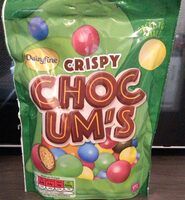
Crispy choc Um’s
Unknown brand
Processing
4
Ultra-processed
Group 4 of 4 on the NOVA scale
Additives listed
7
1 we grade moderate or higher
4 of them not yet assessed here
Sugars per 100g
60g
High
UK FSA front of pack threshold
Three separate readings, kept apart on purpose. This is not a score, and none of it says this product is harmful.
Additives (7)
This label lists 3 colours, 2 glazing agents, 1 emulsifier and 1 thickener or gelling agent.
E171
Titanium dioxide
Whitener and opacifier
What it is. A bright white pigment used to make sweets, icing, sauces and coatings look opaque and white.
Why it is used. Purely cosmetic. It changes appearance, not taste or safety of the food.
What the evidence says. In 2021 the EU food safety body EFSA concluded it could no longer be considered safe as a food additive, mainly because possible genetic damage from the tiny particles could not be ruled out. That is a precautionary call rather than proof of harm in people.
Banned as a food additive in the EU since 2022. Still permitted in the UK and the US, which reached different conclusions on the same evidence. A clear case of the same additive, different rules.
Assessed against EFSA, UK FSA, US FDA. Full entry for E171
E160A
Carotenes
Yellow to orange colour
What it is. The orange pigments found in carrots and other vegetables, either extracted or made synthetically.
Why it is used. Colours margarine, soft drinks, dairy, and sweets.
What the evidence says. The same compound the body turns into vitamin A, and safe at the levels used in food. High dose beta-carotene supplements have been linked to harm in smokers, but those doses are far above anything a colour in food delivers, and conflating the two is a common mistake.
Permitted. The supplement findings apply to concentrated doses, not to food colouring.
Assessed against EFSA, JECFA. Full entry for E160A
E322
Lecithin
Emulsifier
What it is. A natural emulsifier, usually from soya or sunflower.
Why it is used. Keeps chocolate smooth and stops ingredients separating.
What the evidence says. Safe and widely used. Only relevant if the source, such as soya, is an allergen for you.
Permitted freely. Source allergen must be declared.
Assessed against EFSA, JECFA. Full entry for E322
Also on the label, not assessed here yet
- E120 Cochineal, carminic acid, carmines colour
- E414 Acacia gum (gum arabic) thickener
- E901 Beeswax glazing agent
- E903 Carnauba wax glazing agent
Names and jobs come from the register of additives permitted in Great Britain, which we have not finished transcribing: a code shown without a name is a gap in our coverage, not a finding that it is unapproved. Naming one is not grading it either. Full detail appears only where we have an assessment against a named authority, so all of this describes our coverage rather than these additives. Most are common and low concern.
Ingredients
milk chocolate (60%) (sugar, cocoa butter, whole milk powder, cocoa mass, emulsifier: lecithins (soya), flavouring), sugar, crispy centre (10%) (rice flour, maize flour, sugar, modified potato starch, wh dowder (milk), fat reduced cocoa powder, salt, flavouring), colours: titanium dioxide, cochineal, brilliant blue, carotenes, currıumin: glazing agents: gum arabic, carnauba wax, beeswäx, milk chocolate contains cocoa suctds 32% minimum, milk solids 21% minimum,
As printed on the pack, in the producer's own order: ingredients are listed by weight, so what comes first is most of what is in it. E numbers link to their assessment where we have one.