
Cherry Bakewell flavour Jaffa Cakes
Processing
4
Ultra-processed
Group 4 of 4 on the NOVA scale
Additives listed
8
0 we grade moderate or higher
4 of them not yet assessed here
Sugars per 100g
56g
High
UK FSA front of pack threshold
Three separate readings, kept apart on purpose. This is not a score, and none of it says this product is harmful.
Additives (8)
This label lists 2 acidity regulators, 2 emulsifiers, 2 raising agents, 1 sweetener and 1 thickener or gelling agent.
E420
Sorbitol
Sweetener and humectant
What it is. A sugar alcohol, about half as sweet as sugar, which also holds moisture.
Why it is used. Used in sugar free sweets and gum, and to keep baked goods soft.
What the evidence says. Not a toxicity question at all. Sugar alcohols are poorly absorbed, so a large amount draws water into the gut and has a laxative effect. That is well established, predictable and dose dependent, which is why the label has to say so.
Permitted. Foods with more than 10 per cent polyols must carry the statement that excessive consumption may produce laxative effects.
Assessed against EFSA, UK FSA. Full entry for E420
E471
Mono- and diglycerides of fatty acids
Emulsifier
What it is. Fat derived emulsifiers, closely related to ordinary dietary fats.
Why it is used. One of the most used additives in food: bread, margarine, ice cream, cakes and sauces.
What the evidence says. The body handles these much as it handles other fats, and EFSA's re-evaluation raised no safety concern at the levels used. They sit in the same broad emulsifier and gut microbiome research question as the others, which remains unsettled.
Permitted without a numerical limit. The fat source is not always stated, which matters for some diets rather than for safety.
Assessed against EFSA. Full entry for E471
E322
Lecithin
Emulsifier
What it is. A natural emulsifier, usually from soya or sunflower.
Why it is used. Keeps chocolate smooth and stops ingredients separating.
What the evidence says. Safe and widely used. Only relevant if the source, such as soya, is an allergen for you.
Permitted freely. Source allergen must be declared.
Assessed against EFSA, JECFA. Full entry for E322
E330
Citric acid
Acidity regulator
What it is. A mild acid found naturally in citrus fruit, made commercially by fermentation.
Why it is used. Adds tartness, balances flavour and helps preserve. One of the most used additives in food.
What the evidence says. Safe at food levels. No credible health concern for the additive itself.
Permitted freely.
Assessed against EFSA, JECFA. Full entry for E330
Also on the label, not assessed here yet
- E331 Sodium citrates acidity regulator
- E440 Pectin thickener
- E500 Sodium carbonates raising agent
- E503 Ammonium carbonates raising agent
Names and jobs come from the register of additives permitted in Great Britain, which we have not finished transcribing: a code shown without a name is a gap in our coverage, not a finding that it is unapproved. Naming one is not grading it either. Full detail appears only where we have an assessment against a named authority, so all of this describes our coverage rather than these additives. Most are common and low concern.
Ingredients
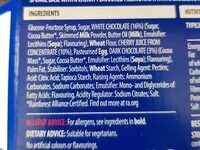
Glucose-Fructose Syrup, Sugar, WHITE CHOCOLATE (16%) (Sugar, Cocoa Butter*, Skimmed Milk Powder, Butter Oil (Milk), Emulsifier: Lecithins (Soya); Flavouring), Wheat Flour, CHERRY JUICE FROM CONCENTRATE (10%), Pasteurised Egg, DARK CHOCOLATE (3%) (Cocoa Mass*, Sugar, Cocoa Butter*, Emulsifier: Lecithins (Soya); Flavouring), Palm Fat, Stabiliser: Sorbitols; Wheat Starch, Gelling Agent: Pectins; Acid: Citric Acid; Tapioca Starch, Raising Agents: Ammonium Carbonates, Sodium Carbonates; Emulsifier: Mono - and Diglycerides of Fatty Acids; Flavouring, Acidity Regulator: Sodium Citrates; Salt
As printed on the pack, in the producer's own order: ingredients are listed by weight, so what comes first is most of what is in it. E numbers link to their assessment where we have one.