
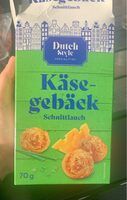
Käsegebäck, Schnittlauch
Unknown brand
Processing
4
Ultra-processed
Group 4 of 4 on the NOVA scale
Additives listed
6
1 we grade moderate or higher
3 of them not yet assessed here
Fat per 100g
53.30g
High
UK FSA front of pack threshold
Three separate readings, kept apart on purpose. This is not a score, and none of it says this product is harmful.
Additives (6)
This label lists 1 acidity regulator, 1 colour, 1 preservative, 1 raising agent, 1 sweetener and 1 thickener or gelling agent.
E251
Sodium nitrate
Preservative, cured meats and some cheeses
What it is. A curing agent that slowly converts to nitrite in the product, giving a longer acting preservative effect.
Why it is used. Used in dry cured meats and a few traditional cheeses.
What the evidence says. Sits under the same processed meat evidence as nitrite, since it ends up as nitrite in the food. Same practical takeaway: the issue is regular processed meat intake, not a trace in one meal.
Permitted with maximum levels, tightened in the EU alongside nitrite.
Assessed against IARC, EFSA, UK FSA. Full entry for E251
E420
Sorbitol
Sweetener and humectant
What it is. A sugar alcohol, about half as sweet as sugar, which also holds moisture.
Why it is used. Used in sugar free sweets and gum, and to keep baked goods soft.
What the evidence says. Not a toxicity question at all. Sugar alcohols are poorly absorbed, so a large amount draws water into the gut and has a laxative effect. That is well established, predictable and dose dependent, which is why the label has to say so.
Permitted. Foods with more than 10 per cent polyols must carry the statement that excessive consumption may produce laxative effects.
Assessed against EFSA, UK FSA. Full entry for E420
E415
Xanthan gum
Thickener and stabiliser
What it is. A fibre made by fermenting sugars with a bacterium, which thickens liquids at very low doses.
Why it is used. Thickens sauces and dressings and gives structure to gluten free baking.
What the evidence says. Passes through largely undigested and is treated as safe by regulators, with no numerical intake limit. Very large amounts act as fibre does, which is a digestive effect rather than a safety one.
Permitted freely.
Assessed against EFSA, JECFA. Full entry for E415
Also on the label, not assessed here yet
- E160B Annatto, bixin, norbixin colour
- E503 Ammonium carbonates raising agent
- E575 Glucono-delta-lactone acidity regulator
Names and jobs come from the register of additives permitted in Great Britain, which we have not finished transcribing: a code shown without a name is a gap in our coverage, not a finding that it is unapproved. Naming one is not grading it either. Full detail appears only where we have an assessment against a named authority, so all of this describes our coverage rather than these additives. Most are common and low concern.
Ingredients
Plantaardige oliën (palmpit, raapzaad, zonnebloem, palm), ei*, zoete weipoeder (melk), rijstebloem, tarwebloem, paneermeel (tarwebloem, zout, gist, rijsmiddel: ammoniumcarbonaten), 4,3 % kaas (melk, zout, zuursel, stremsel, conserveermiddel: natriumnitraat, kleurstof: annatto norbixine), 4,3% roomkaaspoeder (room (melk), zuursel, zout), stabilisator: sorbitolen; rijstzetmeel, tarwezetmeel, zure roompoeder (weipoeder (melk), melkpoeder, zure room (melk)), ui, aardappelzetmeel, zout, 0,4% bieslook, knoflook, rijsmiddelen: natriumcarbonaten, glucono-delta-lacton; aroma, dille, verdikkingsmiddel: xanthaangom. *van scharreleieren. Kan sporen van vis bevatten. Tegen warmte en vochtigheid bescherrmen. Ôngeopend,
As printed on the pack, in the producer's own order: ingredients are listed by weight, so what comes first is most of what is in it. E numbers link to their assessment where we have one.