
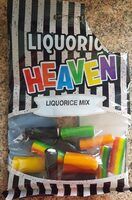
liquorice heaven liquorice mix
Unknown brand
Processing
4
Ultra-processed
Group 4 of 4 on the NOVA scale
Additives listed
10
3 we grade moderate or higher
5 of them not yet assessed here
Nutrients
–
Nothing above the low band
Or no figures recorded at all
Three separate readings, kept apart on purpose. This is not a score, and none of it says this product is harmful.
Additives (10)
This label lists 8 colours, 1 emulsifier and 1 additive.
E110
Sunset Yellow FCF
Orange-yellow colour
What it is. A synthetic orange yellow dye.
Why it is used. Colours squashes, sweets, snacks and desserts.
What the evidence says. Also one of the Southampton Six, carrying the same signal for hyperactivity in sensitive children.
UK and EU require the children's activity warning. Permitted in the US.
Assessed against UK FSA, EFSA. Full entry for E110
E129
Allura Red AC
Red colour
What it is. A synthetic red dye, sometimes labelled Red 40 in the US.
Why it is used. Colours sweets, drinks, cereals and baked goods.
What the evidence says. Another Southampton Six colour. Beyond the hyperactivity signal, some newer animal research on gut inflammation has renewed interest, though that is early and not settled in humans.
Children's activity warning in the UK and EU. In the US it remains permitted, though several states have moved to restrict synthetic dyes in school food.
Assessed against UK FSA, EFSA, US FDA. Full entry for E129
E171
Titanium dioxide
Whitener and opacifier
What it is. A bright white pigment used to make sweets, icing, sauces and coatings look opaque and white.
Why it is used. Purely cosmetic. It changes appearance, not taste or safety of the food.
What the evidence says. In 2021 the EU food safety body EFSA concluded it could no longer be considered safe as a food additive, mainly because possible genetic damage from the tiny particles could not be ruled out. That is a precautionary call rather than proof of harm in people.
Banned as a food additive in the EU since 2022. Still permitted in the UK and the US, which reached different conclusions on the same evidence. A clear case of the same additive, different rules.
Assessed against EFSA, UK FSA, US FDA. Full entry for E171
E471
Mono- and diglycerides of fatty acids
Emulsifier
What it is. Fat derived emulsifiers, closely related to ordinary dietary fats.
Why it is used. One of the most used additives in food: bread, margarine, ice cream, cakes and sauces.
What the evidence says. The body handles these much as it handles other fats, and EFSA's re-evaluation raised no safety concern at the levels used. They sit in the same broad emulsifier and gut microbiome research question as the others, which remains unsettled.
Permitted without a numerical limit. The fat source is not always stated, which matters for some diets rather than for safety.
Assessed against EFSA. Full entry for E471
E100
Curcumin
Yellow colour
What it is. The yellow pigment from turmeric root.
Why it is used. Colours mustards, sauces, dairy, confectionery and savoury snacks.
What the evidence says. A plant pigment people have eaten as a spice for a very long time, and regulators treat it as safe with an acceptable daily intake. EFSA noted that children who eat a lot of the foods it is used in could approach that intake, which is a reason to watch total use rather than a sign of harm.
Permitted with maximum levels in the foods where it is allowed.
Assessed against EFSA, JECFA. Full entry for E100
Also on the label, not assessed here yet
- E120 Cochineal, carminic acid, carmines colour
- E133 Brilliant blue FCF colour
- E153 Vegetable carbon colour
- E160C Paprika extract, capsanthin colour
- E422 Glycerol other
Names and jobs come from the register of additives permitted in Great Britain, which we have not finished transcribing: a code shown without a name is a gap in our coverage, not a finding that it is unapproved. Naming one is not grading it either. Full detail appears only where we have an assessment against a named authority, so all of this describes our coverage rather than these additives. Most are common and low concern.
Ingredients
glucose and fructose syrup, wheat flour (gluten), sugar, starch, liquorice extract, vegetable fat (palm, coconut), vegetable oil (palm, coconut), salt, humectant: e422; emulsifier: e471; flavourings, colours: e100, e110, e120, e129, e133, e153, e160c, e171.
As printed on the pack, in the producer's own order: ingredients are listed by weight, so what comes first is most of what is in it. E numbers link to their assessment where we have one.