
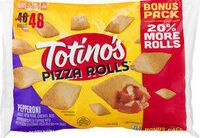
Pizza rolls pizza snacks
Tortino's
Processing
4
Ultra-processed
Group 4 of 4 on the NOVA scale
Additives listed
11
3 we grade moderate or higher
6 of them not yet assessed here
Fat per 100g
10.59g
Medium
UK FSA front of pack threshold
Three separate readings, kept apart on purpose. This is not a score, and none of it says this product is harmful.
Additives (11)
This label lists 3 antioxidants, 2 acidity regulators, 2 colours, 2 preservatives and 1 thickener or gelling agent. 1 more we cannot place from the code alone.
E250
Sodium nitrite
Preservative and colour fixer, cured meats
What it is. A curing salt that keeps cured and processed meats pink and stops the growth of the bacteria behind botulism.
Why it is used. Used in bacon, ham, salami and hot dogs for preservation, safety and colour.
What the evidence says. The concern is not the additive in isolation but processed meat as a whole, which the WHO's cancer agency IARC classes as Group 1, meaning there is sufficient evidence it causes colorectal cancer. Nitrite can form nitrosamines during curing and cooking, and those are the likely culprit. Risk rises with how much processed meat you eat over time.
Permitted with strict maximum levels. The EU cut the allowed limits further from 2023 to reduce nitrosamine formation.
Assessed against IARC, EFSA, UK FSA. Full entry for E250
E171
Titanium dioxide
Whitener and opacifier
What it is. A bright white pigment used to make sweets, icing, sauces and coatings look opaque and white.
Why it is used. Purely cosmetic. It changes appearance, not taste or safety of the food.
What the evidence says. In 2021 the EU food safety body EFSA concluded it could no longer be considered safe as a food additive, mainly because possible genetic damage from the tiny particles could not be ruled out. That is a precautionary call rather than proof of harm in people.
Banned as a food additive in the EU since 2022. Still permitted in the UK and the US, which reached different conclusions on the same evidence. A clear case of the same additive, different rules.
Assessed against EFSA, UK FSA, US FDA. Full entry for E171
E320
BHA (butylated hydroxyanisole)
Antioxidant
What it is. A synthetic antioxidant that stops fats and oils going rancid.
Why it is used. Used in some fatty foods, snacks and chewing gum.
What the evidence says. IARC lists it as possibly carcinogenic based mainly on high dose animal studies. Human relevance at food levels is uncertain, and it is used in small amounts, but it is one to watch rather than dismiss.
Permitted with limits. Its use has declined as makers switch to natural antioxidants like vitamin E.
Assessed against IARC, EFSA. Full entry for E320
E202
Potassium sorbate
Preservative
What it is. The potassium salt of sorbic acid, which stops mould and yeast growth.
Why it is used. Used in cheese, baked goods, dried fruit, wine and dressings.
What the evidence says. Widely used and long regarded as one of the gentler preservatives. EFSA's 2015 re-evaluation lowered the acceptable daily intake and noted gaps in the genotoxicity data, asking for more work, while finding no evidence of harm at the levels actually used.
Permitted with maximum levels. EFSA has asked for further data rather than restricted it.
Assessed against EFSA. Full entry for E202
E330
Citric acid
Acidity regulator
What it is. A mild acid found naturally in citrus fruit, made commercially by fermentation.
Why it is used. Adds tartness, balances flavour and helps preserve. One of the most used additives in food.
What the evidence says. Safe at food levels. No credible health concern for the additive itself.
Permitted freely.
Assessed against EFSA, JECFA. Full entry for E330
Also on the label, not assessed here yet
- E160C Paprika extract, capsanthin colour
- E319 Tertiary butylhydroquinone (TBHQ) antioxidant
- E321 Butylated hydroxytoluene (BHT) antioxidant
- E331 Sodium citrates acidity regulator
- E461 Methyl cellulose thickener
- E541 No entry in our register
Names and jobs come from the register of additives permitted in Great Britain, which we have not finished transcribing: a code shown without a name is a gap in our coverage, not a finding that it is unapproved. Naming one is not grading it either. Full detail appears only where we have an assessment against a named authority, so all of this describes our coverage rather than these additives. Most are common and low concern.
Ingredients
Enriched Flour (_Wheat_ Flour, Niacin, Ferrous Sulfate, Thiamin Mononitrate, Riboflavin, Folic Acid), Tomato Puree (Water, Tomato Paste), Water, Imitation Mozzarella Cheese (Water, Palm Oil, Rennet Casein, Modified Corn Starch, Soybean Oil, Potato Starch, Cellulose Powder, Vital Wheat _Gluten_, Salt, Sodium Aluminum Phosphate, Potassium Chloride, Citric Acid, Potassium Sorbate [Preservative], Sodium Citrate, Titanium Dioxide [Artificial Color], Sodium Phosphate, Maltodextrin, Magnesium Oxide, Zinc Oxide, Vitamin A Palmitate, Riboflavin, Vitamin B12), Pepperoni Pizza Topping (Pepperoni Made with Pork, Chicken and Beef [Pork, Mechanically Separated Chicken, Beef, Salt, Spice, Dextrose, Oleoresin of Paprika, Sodium Ascorbate, Garlic Powder, Sodium Nitrite, Lactic Acid Starter Culture, BHA, and BHT, and Citric Acid Added to Protect Flavor], Water, Soy Protein Isolate), Canola Oil, Pizza Topping with Pepperoni Seasoning (Pork, Mechanically Separated Chicken, Water, Soy Protein Isolate, Beef, Salt, Spice, Dextrose, Oleoresin of Paprika, Sodium Ascorbate, Garlic Powder, Flavoring, Maltodextrin, Sodium Nitrite, Lactic Acid Starter Culture, BHA, and BHT, and Citric Acid Added to Protect Flavor). Contains 2% or Less of: Modified Corn Starch, Rehydrated Pasteurized Process Nonfat Mozzarella _Cheese_ (Water, Nonfat _Milk_, Cheese Cultures, Salt, Enzymes, Citric Acid, Vitamin A Palmitate, Vitamin B6, Sodium Aluminum Phosphate, Sodium Citrate, Sodium Phosphate), Sugar, Salt, Modified Whey, Defatted Soy Flour, Dried Onion, Spice, Methylcellulose, Rehydrated Enzyme Modified Cheese (Water, Milk, Cheese Cultures, Salt, Enzymes), Maltodextrin, TBHQ (Preservative), Natural Flavor.
As printed on the pack, in the producer's own order: ingredients are listed by weight, so what comes first is most of what is in it. E numbers link to their assessment where we have one.